
Turner 250, Sheerness and ‘The Fighting Temeraire’
Sunday 23rd April 1775, Joseph Mallord William Turner was born in Covent Garden, London. Turner was the son of a barber and wig-maker and from early childhood his artistic talent was both acknowledged and encouraged. A quiet boy, he sketched wherever he went, attracting praise from adults and on occasion small commissions. About 1786, he was sent to Margate, possibly to aid his health, his younger sister Mary-Ann having died a few years before, a loss which would later contribute to his mother’s confinement in Bethlem Hospital.
In 2011, the Turner Contemporary was opened in Margate, reflecting his life-long relationship with the town. In Margate’s light, Turner found inspiration and he sketched, produced watercolours and painted beautiful works in oils but not only of Margate’s sea, sun and sky but also its people, its animals, its buildings. In Margate, Turner also met Sophia Booth, his landlady, and following the death of her husband to cholera in 1833, the two came together, later purchasing a home in Chelsea, where neighbours knew him as ‘The Admiral’ and where Turner died in 1851.
Following his burial in St Paul’s Cathedral, it would be a further five years until Turner’s estate was settled. In 1856, ‘The Turner Bequest’ was given to the nation and today the Tate records almost 32,000 items, including sketchbooks, drawings and watercolours. He had also in his possession nearly 100 oil paintings, which he wanted exhibited in a ‘Turner’s Gallery’ at the National Gallery, which had opened in 1824. This included the painting voted Britain’s greatest in a 2005 BBC poll – 'The Fighting Temeraire tugged to her last birth to be broken up, 1838'.
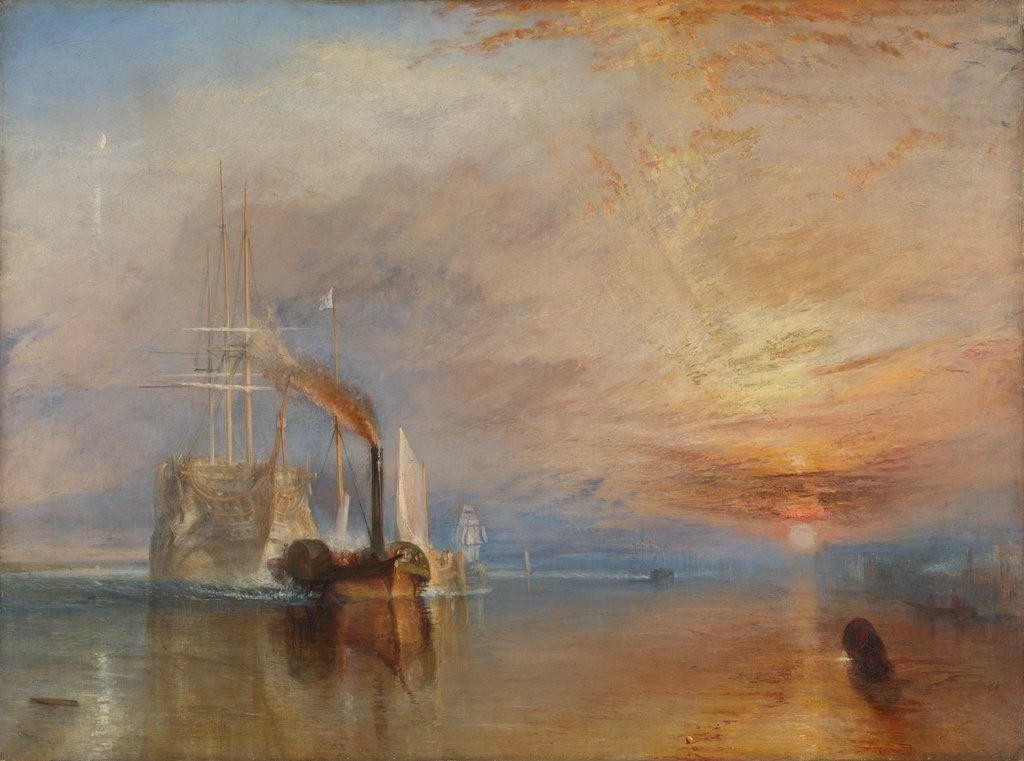
Joseph Mallord William Turner, oil on canvas, 1839. The Fighting Temeraire tugged to her last berth to be broken up, 1838. © The National Gallery, London.
These 32,000 items reveal Turner’s energy and demonstrate his deep interest in Kent. As David Blayney Brown has noted, his passion for the River Medway led to him promoting the idea that he was a Kentish Man. One sketchbook, ‘The Medway Sketchbook’, likely dated to 1821, shows us Turner’s work on the Medway, travelling upon it and along its banks, from Aylesford to Sheerness. He knew its creeks and islands, its ships and boats, its architecture, settlements, sunsets and sunrises.
By 1821, Sheerness had already featured in Turner’s output. Thirteen years earlier, he had exhibited at his own gallery two oil paintings, one titled ‘The Confluence of the Thames and Medway’ and the second, which depicted a most brilliant, clear, sunrise, ‘Sheerness as seen from the Nore’. These were soon privately purchased and are now on public display, the former in Petworth House, Sussex and the latter in The Museum of Fine Arts, Houston. Sheerness also formed part of his 1825 ‘Ports of England’ series, within a watercolour that John Ruskin described as ‘one of the noblest sea-pieces which Turner ever produced’.
Eilert Ekwall tells us Sheerness means ‘bright headland’ and this headland was strategically important. Under Henry VIII a fortification was sited to prevent threats to the Medway. In 1665, Samuel Pepys managed the establishment of its naval dockyard. This led to a proliferation in the number and type of vessels at Sheerness, later reflected in Turner’s art, which would also include the warship Temeraire, veteran of Trafalgar, stationed there from 1820 to 1838.
This association of the Temeraire with Sheerness led to Judy Egerton, upon whose work current understandings of Turner’s ‘The Fighting Temeraire’ are based, to wonder if the artist had set his masterpiece there. In her 1995 study, she, however, dismissed this idea on the grounds that the painting’s buildings were too indistinct to be identified, that they did not resemble those shown in his 1808 works and given that these had been sold, Turner did not have them for reference. Egerton concluded that Turner’s ‘The Fighting Temeraire’ was painted entirely from imagination and was set in the Thames, a view reflected in The National Gallery’s most recent 2024 YouTube upload on the painting.
There seems awkward acquiescence in our understanding of the setting of Britain’s ‘greatest painting’. Perhaps, we prefer an imaginary Thames setting because the Medway would complicate our long-standing national affection for Turner’s melancholic sunset. Yet, in 2014, Pieter van der Merwe wrote it was as likely the painting was set in the Medway than the Thames and in a 2016 National Gallery talk, Matthew Morgan tentatively questioned if it was a sunset at all. Indeed, to address Egerton - the buildings can be identified, Sheerness Dockyard is not shown in the 1808 paintings, and in his possession, as we have noted, Turner did have the reference sketchbooks needed.
In Turner’s 250th year, maybe we should just enjoy his work, or, instead, it provides an opportunity to understand better his ‘darling’ and test the theory that the setting of ‘The Fighting Temeraire’ was not imaginary and instead was set it in a very real, very recognisable, Kent maritime location.
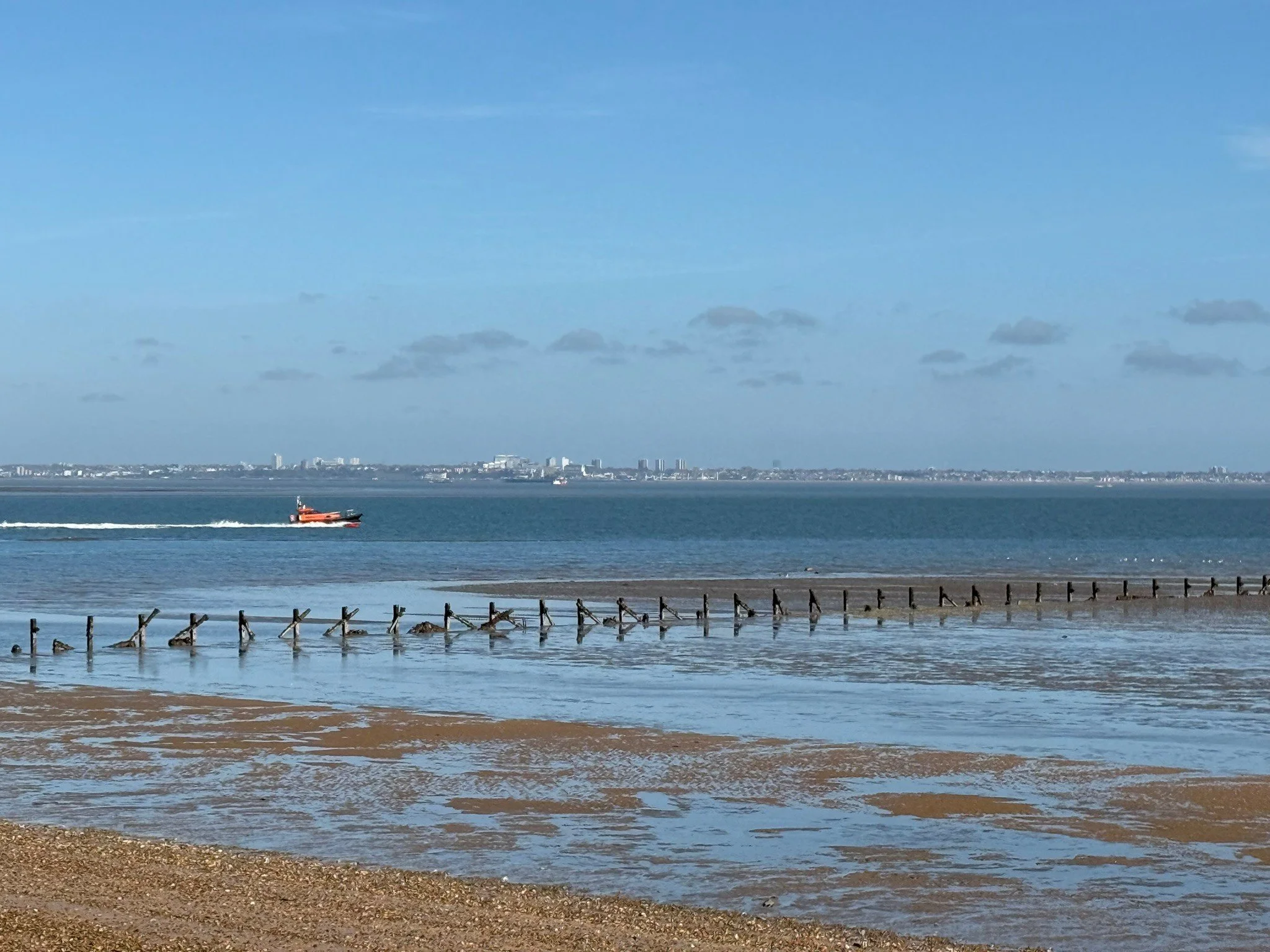
Sheerness looking out to Southend. Photo credit: Stephen Garnett.