Silence of the Sentinels update: Arbeia South Shields Roman Fort
Work on the Silence of the Sentinels Project continued in March 2026 with a visit by members of the team to Arbeia, South Shields Roman Fort, where further analysis was undertaken on two additional skeletons.
During the visit, the skeletons - recovered from within the courtyard of the fort - were carefully laid out and subjected to detailed osteological assessment. This process enabled the team to examine preservation, identify any missing elements, and assess evidence of trauma. As with previous phases of the project, samples were taken for further scientific analysis, including radiocarbon dating and isotope testing. The remains were also extensively photographed, and high-resolution 3D models were produced to support ongoing research and future public engagement.
The context of these burials is particularly significant. The individuals appear to have died around c.390 AD and were not immediately interred; instead, they were allowed to decompose before being buried within the fort itself. Their burial alongside a small number of dogs, as well as associated personal items such as a comb, provides important insight into the circumstances surrounding their deaths and subsequent treatment.
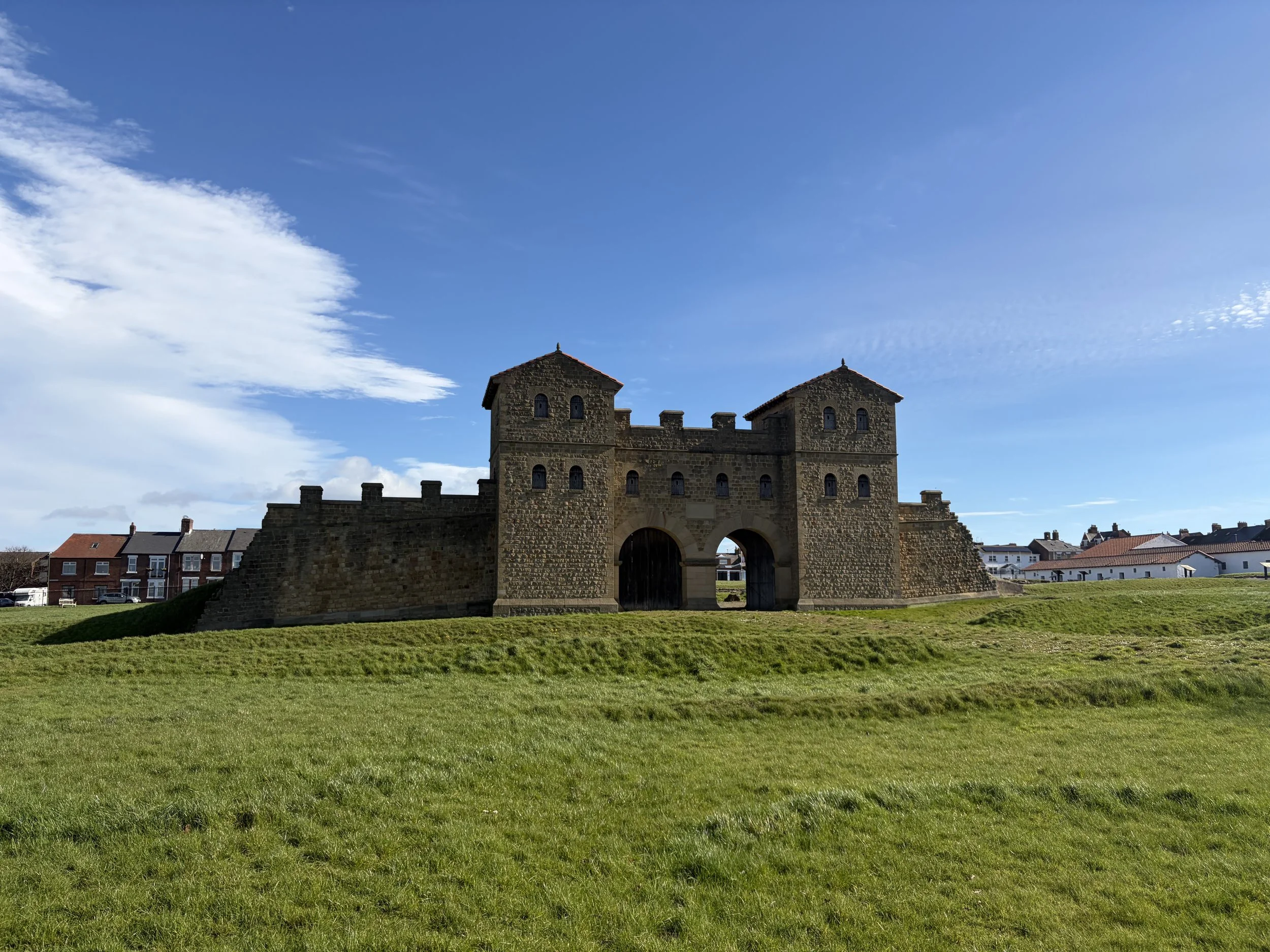
The reconstructed gateway at Arbeia, South Shields Roman Fort.
Crucially, the presence of burials within the courtyard strongly suggests that the fort was no longer functioning as an active military installation at this time. Rather, it appears to have transitioned to civilian use, offering valuable evidence for changing patterns of occupation during the final decades of Roman Britain.
In addition to the osteological work, high-resolution 3D models were also produced of a collection of sculptural stone fragments recovered from the fort, contributing further to the documentation and interpretation of the site.
We are grateful to Alex Croom of North East Museums for facilitating access to the material and supporting the team during this visit.
This phase of work adds an important new dimension to the project, helping to contextualise the violent events being investigated and further illuminate life and death along Britain’s late Roman frontier.
More updates will follow as analysis continues.