
Admiral of the Blue Nicholas Haddock of Wrotham, Kent
Nicholas Haddock, one of four admirals in his seafaring family, had a home in Kent. This post provides highlights of his lengthy career.
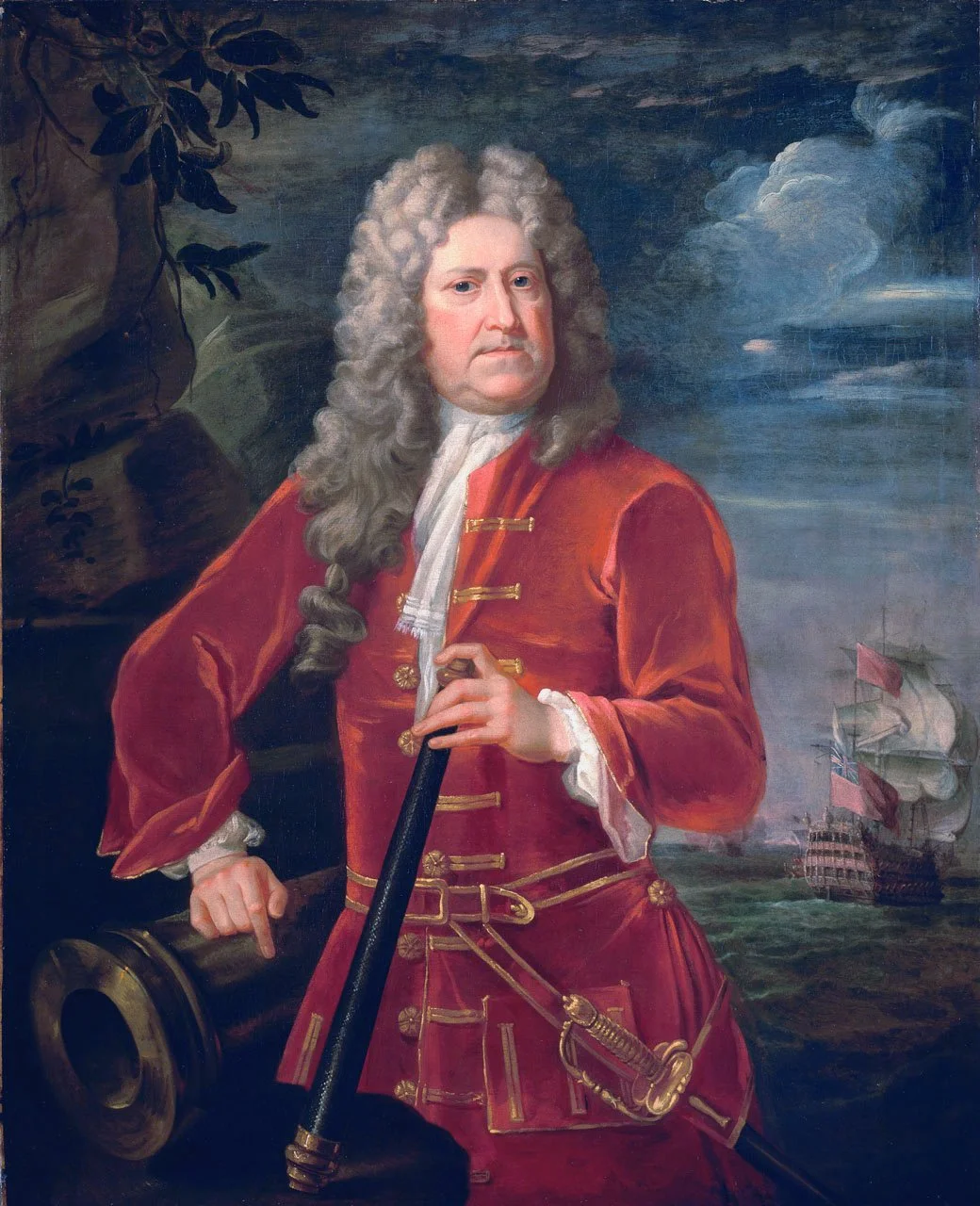
This portrait of Nicholas Haddock was painted about 1742. Unknown artist, Public domain via Wikimedia Commons (original at Royal Museums Greenwich)
One of the more prominent figures in Kent naval history, Nicholas Haddock bought the Wrotham Place estate in 1723. An inscription on a stable rafter indicates the mansion was built in 1462. Haddock lived in the house, when he was not at sea, until his death in 1746.
Born in Leigh-on-Sea, Essex, Nicholas (bap. 8 November 1685) was the youngest child of the respected Admiral Sir Richard Haddock (c.1629–1715), who had twelve children with this two wives. Nicholas had two older brothers who became naval officers. (The 38 seafarers in the family are profiled in the new book, The Haddock Family of English Seafarers: Merchant Mariners and Naval Officers 1327–1941.)
Haddock joined the Royal Navy at age 13 and served more than 43 years, primarily fighting the Spaniards in the Mediterranean. He was often promoted for his brilliant conduct in action, but he would ultimately die a dispirited man after serving at sea under London’s flawed war strategy with contradictory orders and too few ships and men.
Haddock began his career as a Volunteer-Per-Order on the fourth-rate Portland. He was a 16-year-old Midshipman on the third-rate Ranelagh when it captured the Spanish ship Santa Cruz, earning an accolade from his captain. Named a Lieutenant at age 17 (probably aided by his family connections), Haddock steadily advanced. At the young age of 21, he was appointed Captain of the fifth-rate Ludlow Castle.
In 1714 the captain married Frances Emes (1685–1735), a daughter of Captain Fleetwood Emes (d. 1703). The couple would have six children, two of whom died as infants. Haddock would later command the fourth-rate Exeter, the third-rate Shrewsbury, and the third-rate Grafton, all under Admiral Sir George Byng (1663–1733), whose ancestors had once lived in a house near Wrotham Place.
Under the Peace of Utrecht, Spain had lost its Italian empire to Austria, a British ally. In 1718 the Grafton led a chase of 18 Spanish warships off the coast of Sicily. In the Battle of Cape Passaro, the Grafton disabled the Spanish rear admiral’s flagship, earning plaudits for Haddock from the London Gazette.
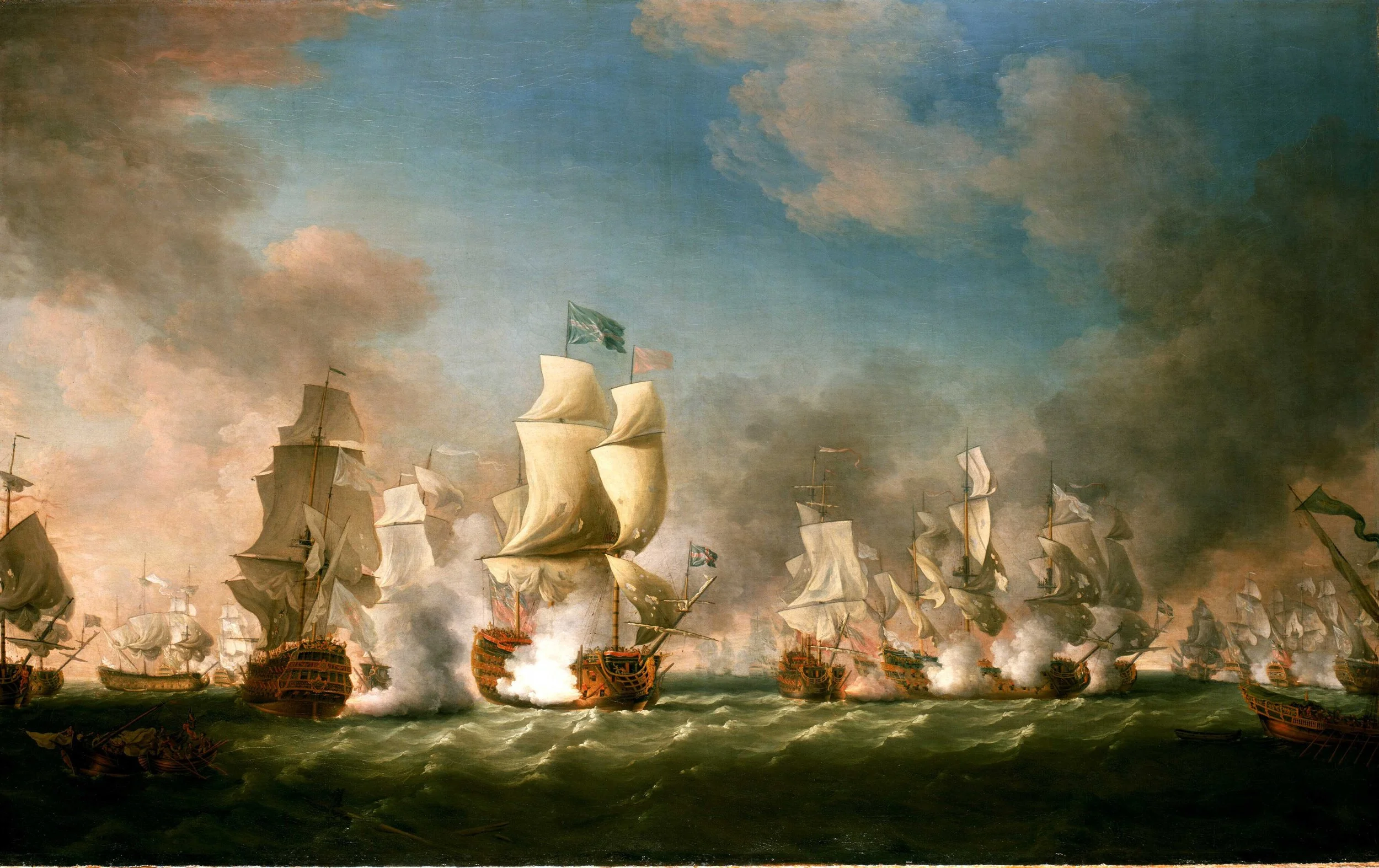
In the 31 July 1718 Battle of Cape Passaro, Admiral George Byng’s 90-gun flagship, the Barfleur (left of center), fires a broadside into the 60-gun San Luis, a Spanish warship. Richard Paton, Public domain via Wikimedia Commons (original at Royal Museums Greenwich)
In 1726 as captain of the third-rate Torbay, flagship of Vice-Admiral Sir Charles Wager (1666–1743), Haddock negotiated with an advisor to Catherine I, who was friendly to Spain. His efforts helped thwart Russia’s expansionist ambitions.
From 1739–48 Britain fought Spain over Caribbean trade. As Rear Admiral of the Red and Commander in Chief of the Mediterranean Fleet, Haddock repeatedly requested reinforcements. He successfully blockaded Barcelona and Cádiz, capturing several rich treasure ships. However, he was also ordered to defend the British base at Minorca—more than 600 nautical miles away. Further, he was to prevent transportation of a Spanish army from Barcelona to Italy and halt the French fleet at Toulon from supporting its Spanish allies.
In December 1741 Haddock was forced to sail to Gibraltar to refit. The Spanish escaped the blockade and the French, with whom Britain was not at war, rendezvoused with the Spanish. The combined fleet (27 ships against Haddock’s 13, a superiority he could not overcome) convoyed the Spanish troops to Italy.
Exhausted from four years at sea, Haddock resigned his command in early 1742, returned to England, and did not go to sea again. The politically clever secretary of state, dodging his own responsibility, blamed the failure to stop the fleets’ junction entirely on Haddock. However, general frustration over the war’s conduct, particularly in the House of Lords, would ultimately contribute to the downfall of the Walpole administration.
In June 1744, four months after France declared war with Britain, Haddock was promoted to Admiral of the Blue. He died shortly before his 61st birthday and is buried in Leigh.
The highlights above are from The Haddock Family of English Seafarers: Merchant Mariners and Naval Officers 1327–1941 by Judy S. Purcell. The richly illustrated book provides full biographies of the Haddock seamen.
For more information see: https://coraclegroup.com
Or contact: https://coraclegroup.com/contact/
