
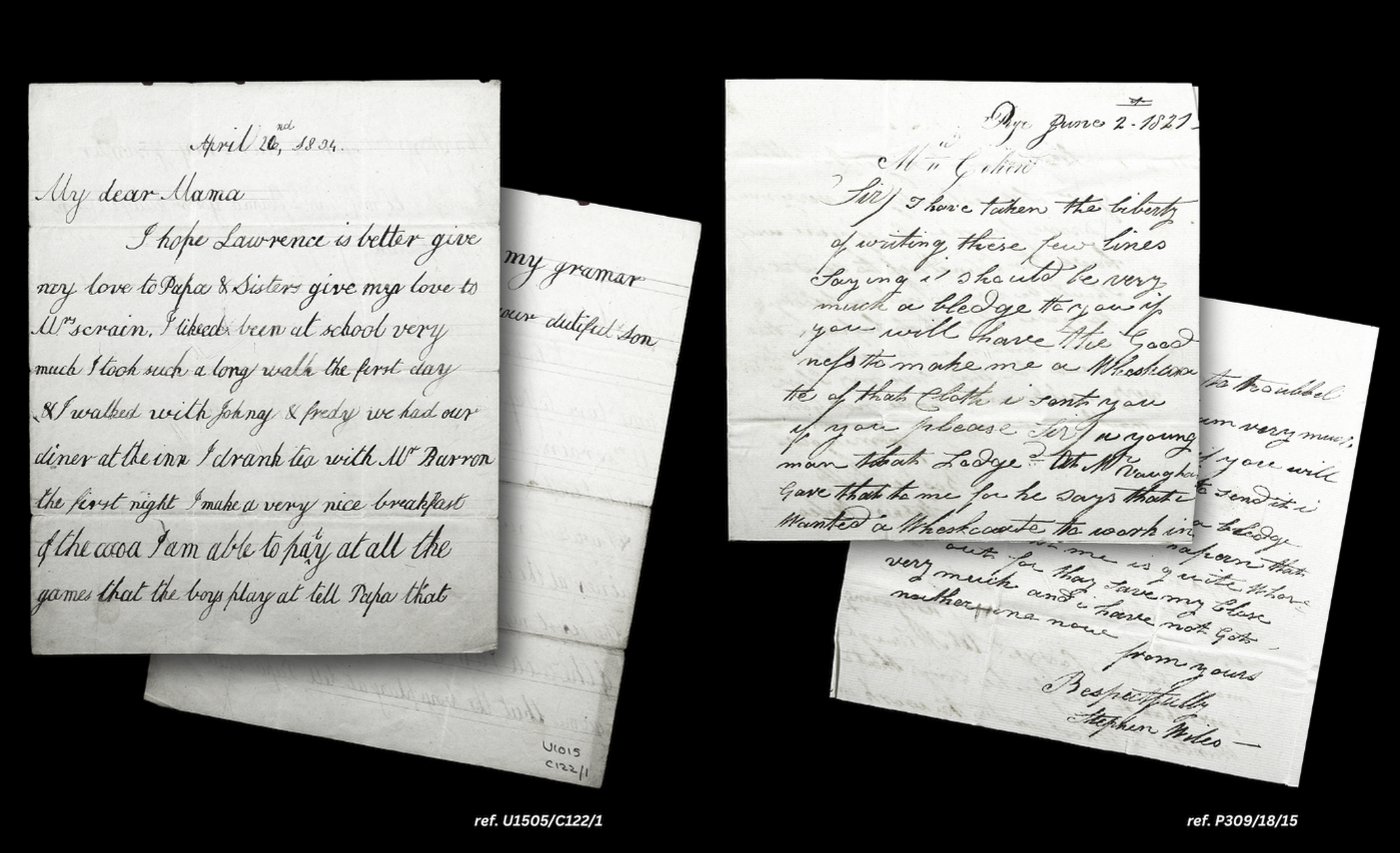
Philip Oxenden Papillon (aged 7) updates his mother about school [ref. U1505/C122/1]; Stephen Wiles (aged 19) requests a new waist coat from the New Romney overseer [ref. P309/18/15]
'The past is a foreign country. They do things differently there.'
– L.P. Hartley, 1953
After the dissolution of the monasteries, the UK gentry organised most schooling of reading and writing, to prepare children for ‘that state of life, unto which it shall please God to call me’ (Church of England catechism) – classical instruction for their own children and, from the Industrial Revolution, mechanical drills for children ‘called to a mechanical state of life’ – until the late nineteenth century.
By comparing four letters held by Kent Archives, which two boys wrote, we see some consequences of two different educations and schoolings: 1) the first and last of eight letters, which a labourer’s son (aged 19-20, in the fourth and fifth years of his five-year apprenticeship to a watchmaker and silversmith) wrote to his parish overseer, dated 1821-22; and 2) the first and last of five letters, which a gentleman’s son (aged 7-8, in his first two years at boarding school) wrote to his parents, dated 1834-35.
Tony Fairman was trained in linguistics for teaching English as a second or foreign language, and taught for many years in Africa. For the past 20+ years he has researched and published on LALPs (Letters of Artisans and the Labouring Poor) applying to English parishes for poor relief, from 1750-1834. He is also interested in anything written by children during the same period.
ADMISSION: FREE
For further information and to reserve a seat
Call: 03000 420673 Email: archives@kent.gov.uk