
The Kent Archaeological Society will soon be returning to the Lees Court Estate! Please put the 5th May to the 28th June in your diary as we return to investigate a possible Neolithic long barrow hidden in the nearby woodlands.
Is there a barrow hiding in the underground at the Lees Court Estate? Over May and June we hope to find out.
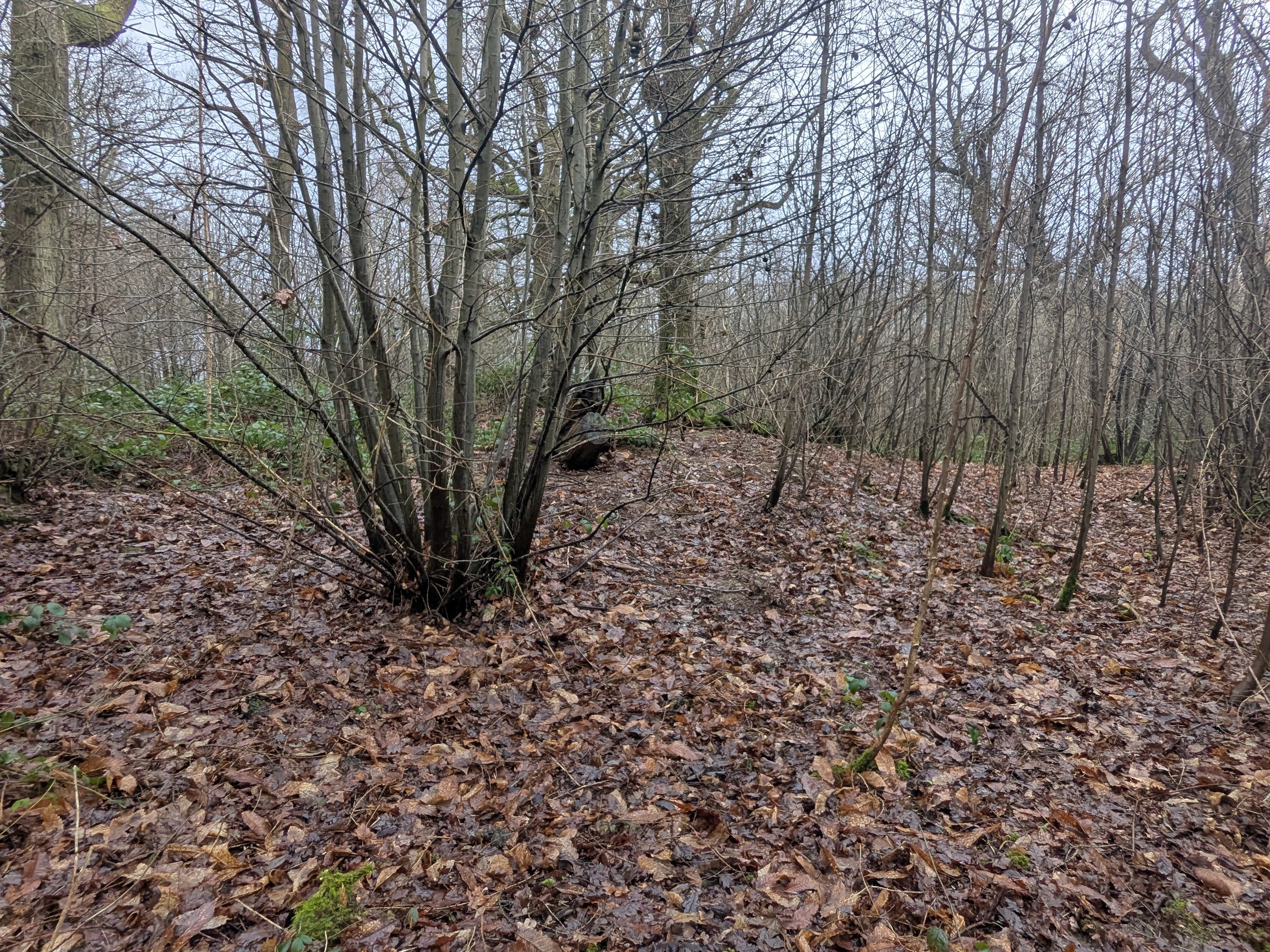
A probable prehistoric barrow mound in Badlesmere Park Wood, Lees Court Estate
Outline Written Scheme of Investigation for evaluation trenching
Keith Parfitt, BA; FSA; MCIfA, January 2025
A probable prehistoric barrow mound in Badlesmere Park Wood
Location of the mound
The mound is located in Badlesmere Park Wood. Grid Reference: TR 02060 54293. The geology is Chalk, and the elevation is 94m (309ft OD), slightly above the 300ft contour on the OS map.
Although not designated Ancient Woodland, the area has been wooded since at least the late 18th century. The Tithe map labels it "Stocking Wood," depicting clumps of trees and scrub. The woodland was likely replanted between 1840–1870 as part of the Sondes estate, becoming Badlesmere Park Wood. Straight woodland paths—likely from the 19th century—cross the area, including one cutting through the mound. This path appears to be the result of deliberate excavation rather than long-term use, as it lacks continuation beyond the mound. The path itself holds minimal archaeological interest.
Organisation and access to the site
Volunteers will access the site via an uphill walk across Butcher’s Neck Field. A KAS tent will be placed near the woodland edge; tools and a site cabin will be stored in Stringman’s Park Field. Toilets will be in the car park as in previous years, which will be fenced with orange safety barriers to protect tree growth. Tools will be transported daily; any finds will be returned at day’s end.
2025 Work Programme
The Estate Team has cleared surface vegetation from the mound.
Initial tasks:
Search the mound for struck flints, etc.
Clean the old trackway to produce mound sections.
Carefully sample the buried land surface expected beneath the mound.
Extend trenches outward to locate any enclosing ditches (possibly similar to those at Stringman’s).
Backfilling likely by hand, possibly requiring landscaping.
Due to site isolation, plastic Netlon fencing should suffice around the excavation area.
Work Dates
Start: Monday 5th May 2025 (Bank Holiday)
End: Saturday 28th June 2025
Schedule: Daily except Sundays (Saturdays included)
Hours: 10:00 – 16:30
Thoughts on Interpretation of the Mound
The mound is early and weathered, cut by two Victorian paths. It's not mapped or known to estate staff.
Shape: Oval — approx. 25m (NW–SE) × 12m (NE–SW) (82ft × 40ft)
Hypothesis:
Might be a short long barrow (Neolithic), not a round barrow (Bronze Age).
If a long barrow, it would align with the Stour Valley group (e.g., Julliberries Grave, Chilham), making it a significant new find.
Strategy:
Focus on dating, not full excavation.
If confirmed prehistoric, Historic England may consider scheduling—depending on preservation.
Members will receive further details via their KAS registered email addresses. Stay tuned for more!